

Haitian communities have rarely been consulted in the international search for solutions to the country's ongoing social, economic and political problems following the devastating 12 January earthquake, Haitian and Dominican civil society and faith leaders have said.
Speaking at a meeting in the Dominican capital, Santo Domingo, the directors of a number of Progressio partner organisations based in the Dominican Republic and Haiti, including Progressio’s Country Representative for Hispaniola, Sonia Vasquez, said that although major efforts had been made to help resolve the crisis in Haiti following the quake, there was still a great deal of pessisism about the situation in the disaster-stricken nation.
Unprecedented levels of solidarity shown towards Haiti following the events of January 12 created expectations which have still not been met, they added.
Colette Lespinasse, Director of Progressio partner organisation the Haitian Support Group for Refugees and Migrants (GARR), said that the promises made by world leaders at the New York summit in March and at the Punta Cana summit in the Dominican Republic, had still not been acted upon.
Ms Lespinasse said donor countries needed to reach urgent consensus on how to proceed so that positive steps can be taken to improve the situation for the people of Haiti. Companies had lost the capital they need to operate, and people are still living in tents or under canvas - and are increasingly worried about the hurricane season, she said.
“We have seen no improvement whatsoever”, said Ms Lespinasse. “Yes, aid arrived in Haiti during the first three months following the quake, but in terms of reconstruction, nothing has happened at all.”
“People should help themselves and not rely on empty promises”, she added, stressing that “there are no jobs to enable people to generate new sources of income.”
The civil society and faith leaders, including Fr Lazard Wismith of Progressio partner the Jesuit Refugee and Migrant Service and Mario Serrano of Progressio partner Centro Bonó, also said they deplored the lack of leadership in the coordination of aid, the delivery of which is still being hampered by mountains of paperwork before supplies are allowed to cross the Dominican-Haitian border.
The leaders also noted major concerns with regards to the availability of food and general organization of the post emergency situation in Haiti - including lack of water, sanitation and fuel in camps - but said that the security situation was not an issue of current concern.
Other issues raised include:
- The positive levels of solidarity shown towards Haiti by the Dominican Republic after the earthquake;
- The need to reactivate the ‘Joint Bilateral Commission’ between the the Dominican Republic and Haiti, and a “lack of political will from the leaders of the two countries to do this”;
- The need for urgent delivery of international aid pledges;
- The need for greater enforcement of the Dominican Republic’s Migration Act.
Progressio has been working alongside Dominican and Haitian NGOs as part of the Ayuda a Haiti (Help Haiti) platform to ensure the voices and concerns of Haitian communities are heard in the recovery and long-term reconstruction process.
The platform was mobilised in the immediate aftermath of the 12 January quake, the worst tremor to hit Haiti in more than 200 years.
Read the original article (in Spanish)
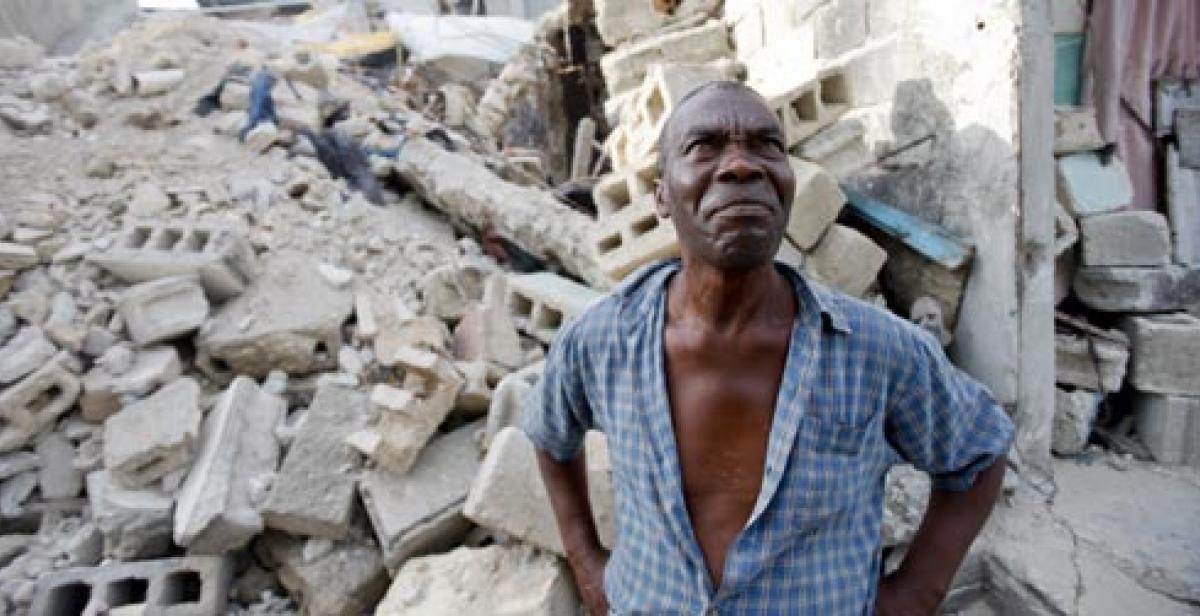
Photo: Wilbert Joseph's house was completely destroyed during Haiti's earthquake. He continues to remove rubble with a shovel and a wheelbarrow (© Natasha Fillion/Progressio).


Comments
Is it naive to hope for earth quake resistant housing for the people of Haiti and how could this be acheived?
Dear Peter
Many thanks for your question.
You raised a very fair point, which is of great concern for many agencies like ours, especially due to the complex social and political context in Haiti.
Firstly, let’s look at the potential obstacles that could affect any housing programme in the country:
1) Tension between the need for providing short-term shelter and building more long-term housing. Given that Haiti (and the whole of the Caribbean region) is going through the hurricane season right now, Haitian people needs short-term housing to survive the weather. However, sustainable housing is a priority to ensure long-term development. So, the question is which of the two should be prioritised?
2) Land tenure/ownership is a serious issue in Haiti, which affects directly where houses will be built. The Haitian government is yet to produce a comprehensive plan for land reform that takes into consideration sustainable planning bearing in mind the needs of the population. What I understand is that a fair amount of the best land suitable for housing construction is in the hands of private owners. If no agreement is achieved for land transfer, unsuitable land should have to be used for building houses, in which case large amount of funds should have to be invested in draining, flooding prevention, etc. Will using ‘bad’ lands be sustainable for long term housing investment?
3) The Action Plan (or PDNA) talks about ‘decentralisation’ and the needs for creating opportunities outside the capital. The earthquake itself brought about a natural displacement of people moving outside of Port au Prince. Choosing where to build houses is key because housing will bring people back to the capital, and if there are plans to decentralise from Port au Prince, logically rebuilding should be done outside of the capital. So, where houses should be built?
4) Skills need to be transferred to the Haitian population for rebuilding to make sure that they are part of this process. In Peru, for example Progressio used the local networks and the community to implement a rebuilding programme, which was supported by a Development Worker but led by the local people, but these sorts of initiatives are notably absent in Haiti. The challenge is how to include the Haitian population to ensure that there is ownership of rebuilding the housing themselves?
Coming back to your question, earthquake resistant housing is possible if we tackle the problems above to ensure that the investment (whether is aid or private investment) is sustainable, and following good examples in earthquake-prone countries like Japan and Chile, that Haiti could capitalise on. In our case, Progressio has a valuable experience of developing earthquake-resistant housing in Ica valley in Peru after a major earthquake in 2007. We decided to place a Development Worker with architectural skills to help the community develop low-cost and easily-built homes; you can read about it here: http://www.progressio.org.uk/content/mar%C3%ADa%E2%80%99s-story
As you can see, it's more than the housing that we need to look into in order to make a success story for Haiti, but it could be achieved by recognising that there are a lot of hurdles we need to go through before we get there. All the key players involved in the reconstruction process would need to work together in order to achieve that success.
Thanks!
Lizzette Robleto, Advocacy Coordinator for Latin America and the Caribbean, Progressio
Thank you Lizzette. We should pray that all the people will accept the great challenges and sacrifices needed to overcome the earthquake problem, as the people of Holland succeeded against the sea in times past. Peter Coates