

Honduras
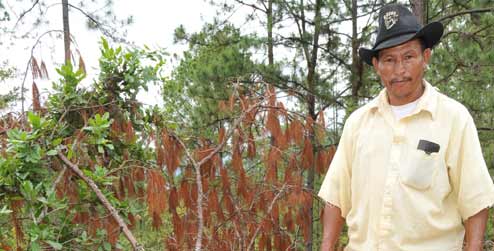
Alberto Granados, a farmer in Olancho, Honduras. Photo © Omar Banegas/Progressio
My name is Xiomara Ventura. I’m the regional manager for Progressio’s work in Central America and I’m based in Honduras.
Things haven't been easy for the people of Honduras. Back in 1998 Hurricane Mitch swept through Honduras with devastating effects. It killed 5,000 people. 70% of the country’s crops were destroyed. It caused billions of dollars worth of damage, and led to economic recession and increased povery.
In truth, it was the last thing that Honduras needed. We’d already lived through years of weak government and corruption. Poverty here is endemic. Unemployment is really high. Lawlessness is a serious problem. And to make matters worse, a military coup in 2009 has meant an increase in social repression and censorship, which has continued despite the election of a new government in November 2009.
But there’s far more to Honduras than these grim facts. It’s a young country – half our population is less than 19 years old. And with youth comes enthusiasm. People here really want a future that doesn’t involve poverty, poor housing and malnutrition.
So we’ve supported local partner organisations to take a lead in tackling poverty – whether this means influencing poverty reduction strategies at a national or local level, or setting up community organisations to deliver local services to neglected communities.
The legacy of Hurricane Mitch is a fragile environment – one that makes poor people vulnerable to increasing poverty. So we have helped local organisations to argue for new laws on water rights, mining, and illegal logging. And we’ve worked with rural communities and small-scale farmers to develop farming techniques that won’t harm the environment, and which provide long-term livelihoods.
We are also focusing on increasing people’s participation in local and national decision-making processes, and in particular, working to help empower women to lead a full and active role in society.
In December 2009 we began to introduce an integrated approach to our work challenging poverty and exclusion in Central America. We work in Honduras, El Salvador and Nicaragua and our aim is to combine our expertise and increase our impact. One early initiative is a new programme, ‘Central America against Climate Change’, which aims to strengthen the resilience of poor communities to face climate change.
