

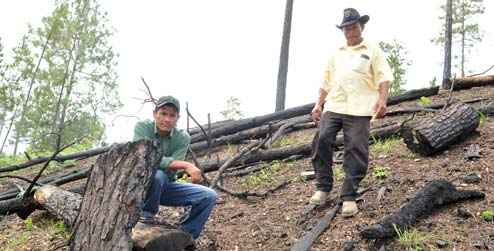
 "If illegal loggers keep sawing down our trees, we will end up with nothing but a desert," says David Amador (left), a farmer in Olancho, Honduras (with Alberto Granados, right)
What is the problem?
Illegal loggers don’t just take wood quietly. They take it by force or by threat. They ride roughshod over local people’s rights and existing use of the land. And anyone who tries to stand up to them fears for their lives. Local people are not left to live in peace.
This is in addition to all the problems you’d expect from wiping out vast swathes of forest: lush ecosystems are destroyed leaving large tracts of bare land. The local water basin becomes exposed and dries up. What is left is like desert. It is hard for local people to feed their families and it increases their poverty. And the global impact? Deforestation generates almost a fifth of greenhouse gases: more carbon than the whole world’s transport system put together.
What are we doing?
Our partners in Latin America and the Caribbean are tackling illegal logging at the source – lobbying for strong laws and monitoring systems to regulate logging, introducing reforestation schemes, supporting local communities in gaining access to and sustainably managing natural resources. In spite of the risks associated with this work, our partners continue trying to persuade their governments that protecting forests is both a social and economic investment for their country's long term sustainability and survival. Our Central America programme continues to develop collaborative work and strategic alliances with other environmental organisations to ensure that this work continues.
We supported our partners' efforts by focusing on the role played by the EU and UK at the end of the supply chain: in other words, the market in the EU and UK for illegally logged wood. We aimed to ensure that the EU and the UK adopted strong and robust legislation to prevent unscrupulous traders from selling illegally logged wood.
In cooperation with the leading global law firm Mayer Brown International, we also produced a Climate Change Legal Reference Guide which sets out key laws on forestry and water in the context of climate change. The guide aims to help organisations working on climate change to understand the key principles underpinning international environmental law. The guide is available to download in English (470k PDF) and Spanish (515k PDF).
What did we achieve?
In April 2010, following lobbying by Progressio, the UK Department for the Environment, Food and Rural Affairs (DEFRA) introduced tough new timber procurement guidelines for the UK public sector. These mean that wood imported into the UK to be used by public bodies such as local authorities, schools and hospitals must come from environmentally sustainable sources and have been produced in a socially responsible way – with respect for community tenure and forest management practices, and safeguards for forest workers’ employment rights.
Some 62% of tropical wood imports to the UK are potentially from illegal sources. If these criteria are rigorously implemented, the public sector will be setting a good example – one which could be a step on the path towards eliminating illegal timber from the UK market for good.
We have also been working to achieve stronger EU regulations. In May 2010, again following lobbying from Progressio supporters, the EU Environment Committee voted in favour of adopting an over-riding prohibition on placing or making available illegally harvested timber on the EU market.
And in October 2010, Regulation (EU) No 995/2010 of the European Parliament and of the Council was adopted laying down the obligations of operators who place timber and timber products on the market – also known as the (Illegal) Timber Regulation or EUTR.
The EU Timber Regulation
This regulation aims at curtailing the trade in illegally harvested timber and timber products through three key obligations:
- It prohibits the placing on the EU market for the first time, of illegally harvested timber and products derived from such timber;
- It requires EU traders who place timber products on the EU market for the first time to exercise 'due diligence';
- It requires EU traders to keep records of their suppliers and customers.
Once on the market, the timber and timber products may be sold on and/or transformed before they reach the final consumer. To facilitate the traceability of timber products, economic operators in this part of the supply chain (referred to as traders in the regulation) have an obligation to keep records of their suppliers and customers.
Consequently the three key elements of the "due diligence system" are:
- Information: The operator must have access to information describing the timber and timber products, country of harvest, species, quantity, details of the supplier and information on compliance with national legislation.
- Risk assessment: The operator should assess the risk of illegal timber in its supply chain, based on the information identified above and taking into account criteria set out in the regulation.
- Risk mitigation: When the assessment shows that there is a risk of illegal timber in the supply chain that risk can be mitigated by requiring additional information and verification from the supplier.
The regulation came into effect on 3 March 2013.
The regulation covers a broad range of timber products including solid wood products, flooring, plywood, pulp and paper. Not included are recycled products, as well as printed papers such as books, magazines and newspapers. The product scope can be amended if necessary.
What challenges remain?
In addition to the regulation, the European Union responded to the problem of illegal logging in timber producing countries by adopting the FLEGT (Forest Law Enforcement, Governance and Trade) Action Plan. This EU FLEGT Action Plan provides a number of measures to exclude illegal timber from markets, to improve the supply of legal timber and to increase the demand for responsible wood products.
A central element of the EU’s strategy to combat illegal logging is trade accords with timber exporting countries, known as Voluntary Partnership Agreements (VPA). These aim to ensure legal timber trade and support good forest governance in the partner countries. Six agreements (with Cameroon, Central African Republic, Ghana, Indonesia, Liberia and the Republic of Congo) have been finalised. Negotiations are on-going with the Democratic Republic of Congo, Gabon, Malaysia and Vietnam. Three other countries are expected to start official negotiations: Ivory Coast, Honduras and Laos. Countries that have expressed an interest include Thailand, Guyana, Bolivia, Madagascar, Sierra Leone and Ecuador.
The increased number of countries interested in negotiating a FLEGT-VPA reflects the impact of the changes in the EU legislation, and more important for Progressio, these include countries from which Progressio drew our testimonies and case studies for our work on illegal logging (namely Honduras and Ecuador).
In spite of these achievements, we should continue keeping a watchful eye over to ensure that the international community protects - and, where appropriate, uses in a sustainable and well-managed manner - our natural resources.
